Aug 5, 2026
Custom Injection Molding & Tooling for Engineering Plastic Parts
From product review, mold design and manufacturing, to trial molding and molding support, a stable and maintainable process foundation is established for the mass production of plastic parts.
Custom Injection Molding & Tooling for Engineering Plastic Parts
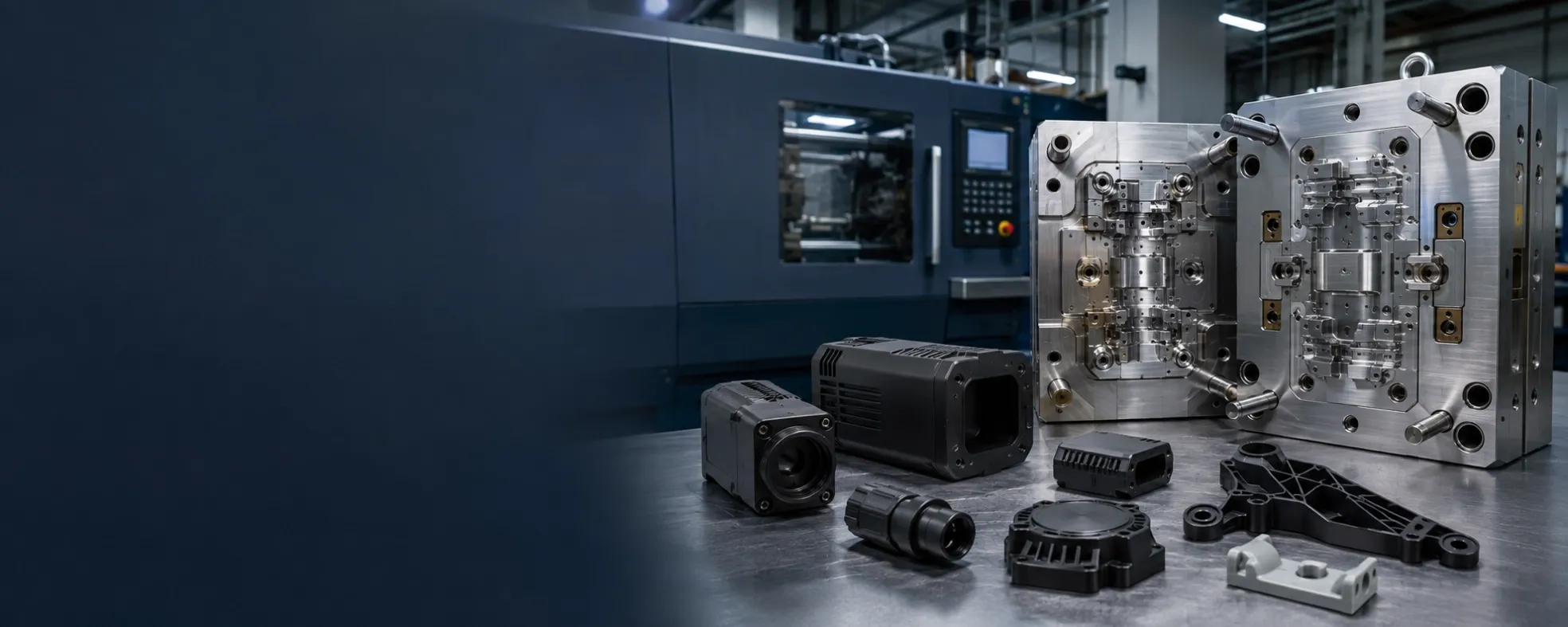
Move custom plastic parts from product review and mold design through toolmaking, T1 trials, optimization and molding support. Our service supports engineering components for AI hardware, robotics, machine vision, industrial electronics, and advanced equipment.
- DFM review before mold design
- Mold design, toolmaking, assembly and T1 trial support
- Mold steel options matched to resin, appearance and production needs
- Review of shrinkage, draft, gates, parting lines, ejectors and cooling
- Mold textures, plating and selected post-molding operations
- Samples, inspection results and maintenance guidance available by project agreement
Get Your Quote
Share your 3D model, 2D drawing, resin grade, color, surface texture, quantities, critical dimensions, tolerance requirements, intended application, and target tooling life.
From Moldability Review to Stable Production
Reliable production begins before steel is cut. Wall thickness, shrinkage, draft, gate position, parting lines, ejectors, cooling, deformation risk, and cosmetic zones must work with the selected resin and mold structure.
We review these factors during the project’s early stage and provide DFM feedback. The goal is a maintainable process foundation for parts requiring repeatability, complex geometry, controlled appearance or post-molding assembly.
Typical Molded Components
- Electronic and edge-AI equipment housings
- Connector covers, bezels and interface panels
- Sensor, camera and machine-vision enclosures
- Robot covers, guards and internal plastic supports
- Fan ducts, airflow guides and cable-management parts
- Equipment handles, knobs, clips and fastening features
- Insulating covers and protective components
- Transparent, optical or cosmetic plastic parts subject to resin and tooling review
These are suitable part categories, not a fixed catalog. Feasibility depends on geometry, resin, appearance, quantities, dimensions, and production conditions.
Applications
- AI hardware and data-center equipment: molded covers, airflow parts, connector interfaces, cable-management components and protective housings.
- Robotics and automation: covers, sensor housings, brackets, guards, clips and user-interface components.
- Machine vision: camera housings, optical-system supports, lighting covers and cosmetic equipment parts.
- Edge AI and industrial electronics: device enclosures, bezels, mounting components, insulating parts and internal structures.
- Scientific equipment: instrument housings, control interfaces and protective covers.
Mold Steel Options
Mold steel | Main characteristics | Typical applications |
S136 / S136H | Corrosion resistance and good polishability | Transparent parts, optical parts and corrosive resins |
718 / 718H | Pre-hardened, uniform hardness and stable overall performance | Medium-to-large molds and exterior parts |
NAK80 | Pre-hardened with good polishing and machining stability | High-appearance and high-precision parts |
P20 | Economical, general-purpose and easy to machine | Medium- or low-volume projects and conventional molds |
H13 | Good thermal-fatigue and wear resistance | High-temperature materials or higher-load applications |
Steel selection considers resin, appearance, volume, mold structure, operating conditions, maintenance, and target tooling life. The grade and condition are confirmed during engineering review.
Injection Mold Design and Toolmaking
Requirements and DFM review: We confirm part function, resin, color, appearance, dimensions, tolerances, annual demand, and available molding-equipment conditions. The design review evaluates wall-thickness transitions, shrinkage, draft, gate position, parting lines, ejector marks, cooling, deformation risk and visible surfaces.
Mold design: Engineering can cover the cavity and core, parting structure, runner and gate, cooling circuit, ejector system and required moving mechanisms. Mold-flow analysis may be considered when the project and risk level justify it.
Tool manufacturing: Mold components can be produced using CNC machining, grinding, EDM, wire cutting, heat treatment and polishing. The exact route depends on steel, geometry, finish, accuracy, and design requirements.
Assembly and T1 trial: After assembly, the T1 trial checks mold filling, shrinkage, warpage, flash, ejector performance, cooling cycle, and key dimensions. Findings become the basis for corrections and process recommendations.
Optimization and delivery: The mold is adjusted according to trial results. The agreed delivery package can include samples, inspection results, recommended molding parameters, and maintenance guidance.
Mold Finishes and Post-Molding Support
Tool surfaces can use mirror polishing, VDI or MT texture, nitriding, hard-chrome plating, or another approved treatment. Define visible areas, texture references, gloss and appearance limits before toolmaking.
Molded parts can also be evaluated for painting, shielding coating, pad printing, silk-screen printing, ultrasonic welding, and mechanical assembly. Confirm compatibility and acceptance criteria during quotation.
Quality Planning and Deliverables
Trial stages focus on appearance, dimensions, assembly, material, process window and defect correction. Quality planning follows the approved drawing, part specification and agreed inspection scope rather than a generic tolerance claim.
Before tool release or production, confirm:
- Drawing revision, resin grade, color and material requirements
- Critical dimensions, tolerances and inspection method
- Gate, parting line, ejector marks and cosmetic-surface limits
- Texture, polish, coating, printing and post-molding operations
- Assembly interfaces, mating parts and functional test needs
- Sample quantity, inspection documents and approval process
- Target tooling life, annual demand and expected molding schedule
- Mold ownership, storage, maintenance and delivery requirements
Agreed deliverables can include samples, inspection reports, mold drawings, material information, recommended molding parameters and maintenance instructions. Confirm any certification or mold-life warranty separately.
Project Workflow
- Send the 3D model, 2D drawing, resin, color, texture, quantities, and application details.
- Receive DFM feedback covering moldability, appearance, dimensional and tooling risks.
- Confirm mold design scope, steel, surface treatment, deliverables, revision, and schedule.
- Manufacture and assemble the mold, then conduct the T1 trial.
- Review samples and inspection results, complete agreed optimization, and approve the process.
- Release the mold and molded parts according to the confirmed project scope.
Why Work With The Finer Parts
- One coordinated route from product review to mold optimization and delivery
- DFM focused on repeatability, appearance, assembly, and maintainability
- Mold steel and processing routes selected around the actual application
- Trial findings connected to corrective actions and molding parameters
- Clear RFQ inputs and project deliverables established before toolmaking
Request an Injection Molding & Tooling Quote
Send your CAD data for moldability and quotation review. To receive a more useful response, include:
- 3D model and revision-controlled 2D drawing
- Resin grade, additives, color and required material documentation
- Prototype or validation quantity, annual demand and production forecast
- Cosmetic surfaces, texture, polish, printing and coating requirements
- Critical dimensions, tolerances, assembly interfaces and inspection needs
- Target tooling life and available molding-machine conditions
- Sample, report, mold-delivery and maintenance requirements
- Target approval date, delivery date and destination country
Frequently Asked Questions
Can you support both mold building and injection molding?
Yes. Projects can be evaluated from DFM and mold design through tool manufacturing, assembly, T1 trials, optimization and molding support. Final scope is confirmed for each project.
Which mold steels are available?
Common options in the supplied capability range include S136/S136H, 718/718H, NAK80, P20 and H13. Selection depends on resin, appearance, volume, load, maintenance and target tooling life.
What is checked during a T1 trial?
The T1 trial can evaluate filling, shrinkage, warpage, flash, ejector performance, cooling cycle and critical dimensions, followed by agreed corrections and parameter recommendations.
Can you provide textures and polished mold surfaces?
Yes. Options can include mirror polishing, VDI or MT textures and project-approved treatments such as nitriding or hard-chrome plating. Specify the required reference and cosmetic zones.
Do you support secondary operations and assembly?
Depending on the design, support can include painting, shielding coating, pad printing, silk-screen printing, ultrasonic welding, and mechanical assembly.
What files and information should I send?
Send a 3D model and 2D drawing, resin, color, finish, quantity, annual demand, critical dimensions, tolerances, application, target tooling life, and molding-equipment conditions.