Aug 5, 2026
Custom Sheet Metal Fabrication for Advanced Equipment
Custom sheet metal fabrication services for AI hardware and advanced equipment, with 0.4–12 mm processing, finishing, assembly and OEM production support.
Custom Sheet Metal Fabrication for Advanced Equipment
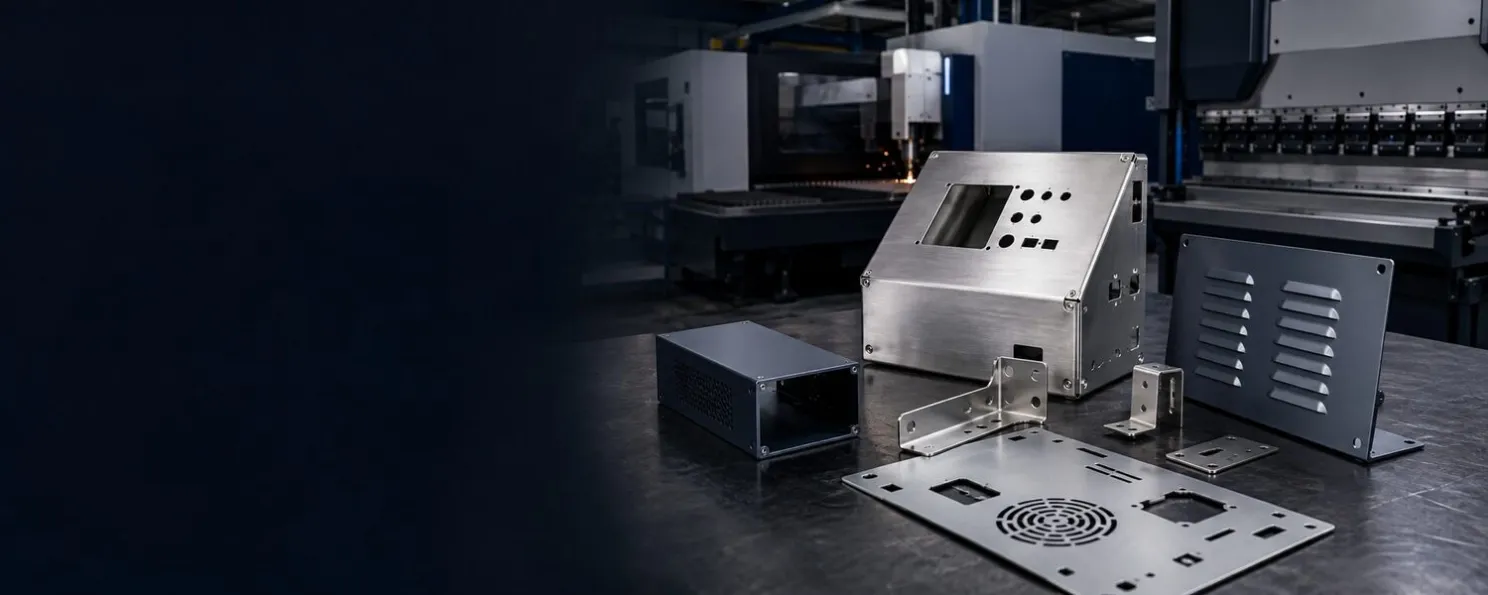
Get custom enclosures, chassis, brackets, panels and structural sheet metal parts for AI hardware, data-center equipment, robotics, machine vision and advanced electronics. We support prototypes, low-volume builds and ongoing production through cutting, punching, bending, forming, welding, finishing and assembly.
- Prototypes, low-volume builds and ongoing production
- Custom enclosures, chassis, panels and brackets
- Common sheet thicknesses of approximately 0.4–12 mm, subject to material and design
- Aluminum, stainless steel, carbon steel, galvanized steel and copper-alloy options
- DFM review for bends, holes, hardware and assembly
- Finishing and hardware-insertion support
Get Your Quote
Upload your 3D model and 2D drawing with quantity, material, thickness, finish, critical dimensions and target delivery date.
Sheet Metal Parts Designed for Assembly
Advanced equipment often requires more than a flat cut part. Enclosures and structural components must account for bend radius, relief, flange length, corner conditions, hole-edge distance, installed hardware, grounding, ventilation, cable routing and final assembly.
Our DFM review evaluates these features together before production. We focus on bend radius, hole-edge distance, weld distortion, assembly gaps, fastener position and compatibility with the specified surface finish.
Typical Sheet Metal Components
- Equipment enclosures, covers and access panels
- Server chassis, rack components and mounting rails
- Custom brackets, supports and reinforcement plates
- Electronic cabinets, control boxes and internal partitions
- Cable trays, routing panels and connector plates
- Pump, fan, sensor and power-supply mounts
- Ventilated panels, guards and protective covers
- Welded frames and sheet metal subassemblies
These are manufacturable part examples, not a fixed product catalog. Final feasibility depends on the drawing, material, thickness, quantity, finish, and inspection requirements.
Applications
- AI servers and data centers: chassis, rack brackets, cable-management parts, power-distribution covers and equipment panels.
- Liquid-cooling systems: CDU enclosures, pump brackets, manifold supports, sealing panels and service-access covers.
- Robotics and automation: controller cabinets, machine guards, sensor brackets, motor covers and structural panels.
- Machine vision: camera-system frames, lighting mounts, protective housings and inspection-equipment panels.
- Edge AI and industrial electronics: compact enclosures, connector panels, heat-management structures and internal frames.
- Scientific equipment: instrument covers, mounting structures, internal partitions and custom equipment cabinets.
Materials
Category | Common grades and typical uses |
Aluminum sheet | 1060, 3003, 5052, 5754, 6061 — lightweight enclosures, panels, brackets and heat-dissipation structures |
Stainless steel | 304, 316 series and project-specified grades — corrosion-resistant equipment, clean-environment parts and high-strength structures |
Carbon and galvanized steel | Cold-rolled steel, SPCC, SECC, SGCC — cabinets, frames, mounting plates and industrial structural parts |
Copper and copper alloys | Copper, brass, beryllium copper — conductive, shielding, heat-dissipation and spring components |
Confirm the exact grade, temper, thickness, surface condition and certification requirements during quotation. Common sheet thicknesses are approximately 0.4–12 mm; the manufacturable range depends on material, part size, equipment, bend structure and tolerance requirements.
Sheet Metal Fabrication Capabilities
Cutting and hole-making can include laser cutting, waterjet cutting, punching, tapping and reaming to create profiles, holes, slots, ventilation patterns and cutouts. The selected route depends on geometry, material, thickness, quantity and edge requirements.
Bending and forming produce flanges, channels, boxes, covers and structural shapes. Bend radius, relief, grain direction, hole position and tool access are reviewed to reduce cracking, distortion and dimensional conflict.
Joining and assembly can include press riveting, tapping, welding, riveting, rivet-nut and stud installation, fastener installation, welded assemblies and simple subassembly work. Weld type, cosmetic expectations, accessible sides and post-weld finishing should be identified on the drawing.
Projects can begin with prototypes or small batches, then move into repeat or ongoing production after the drawing revision and manufacturing route are approved.
Surface Finishes
Available options include powder coating, wet painting, anodizing for suitable aluminum parts, bead blasting, brushing, electroplating, passivation, silk-screen printing and laser marking.
Specify color standard, gloss level, texture, cosmetic surface, masked areas, grounding points and post-finish dimensional requirements before production.
Dimensional and Quality Planning
Sheet metal accuracy depends on material, thickness, part size, bend sequence, tooling, joining method and finish. Quality control follows the approved drawing and checks material, thickness, flat-pattern dimensions, hole position, bend angle, overall dimensions, weld appearance and surface treatment.
Before production, we review:
- Material grade, thickness and flat-pattern dimensions
- Hole positions, bend radii, reliefs, flange dimensions and bend angles
- Weld symbols, hardware, fasteners and assembly interfaces
- Overall dimensions, weld appearance, distortion, cosmetic surfaces and edge requirements
- Finish, color, masking, grounding and marking requirements
- Inspection documents, packaging and delivery requirements
From Drawings to Finished Assemblies
- Share the 3D model, 2D drawing, quantity, material, thickness and finish.
- Receive DFM feedback on bends, holes, hardware, joining and inspection risks.
- Confirm quotation, drawing revision, finish, documentation and delivery scope.
- Produce prototype or first-article parts when validation is required.
- Move approved parts into repeat or ongoing production.
Why Work With The Finer Parts
- Prototype, low-volume and ongoing-production support for custom fabricated parts
- DFM feedback focused on forming, assembly, finish and cost
- Coordination from flat parts through hardware and subassemblies
- Application-aware communication for advanced equipment projects
- Drawing, revision, packaging and shipment requirements clarified before production
Request a Custom Sheet Metal Fabrication Quote
Send your CAD files for manufacturability and quotation review. For a more accurate response, include:
- 3D model and revision-controlled 2D drawing
- Prototype quantity and expected repeat volume
- Material grade, thickness and surface condition
- Flat pattern or 2D drawing, bend requirements and critical dimensions
- Weld requirements and a fastener or hardware list
- Finish, color, texture, masking and inspection requirements
- Target delivery date and destination country
Frequently Asked Questions
What sheet metal parts can you manufacture?
We can evaluate custom enclosures, chassis, brackets, panels, cabinets, covers, rails, guards and fabricated subassemblies from your drawings.
Can you support one prototype or a small batch?
Yes. Prototype and low-volume projects can be evaluated subject to material, tooling, process and finish feasibility.
Which materials are available?
Common options include aluminum 1060/3003/5052/5754/6061, stainless steel 304/316 series, cold-rolled and galvanized steel such as SPCC/SECC/SGCC, plus copper, brass and beryllium copper. Confirm the exact grade and condition during quotation.
What sheet thicknesses can you process?
Common sheet thicknesses are approximately 0.4–12 mm. The actual manufacturable range depends on material, part dimensions, equipment, bend structure and tolerance requirements.
Do you provide welding and hardware insertion?
Joining and assembly can include welding, riveting, fastening and hardware insertion when the design, access and project requirements allow.
What files should I send?
Send a 3D model and 2D drawing, plus quantity, material, thickness, finish, hardware, critical dimensions, target date and delivery destination.